6,000 views Last updated: 25/12/2025 Download PDF (1 pages)
Genre 🎹 Piano, Lead sheet with lyrics
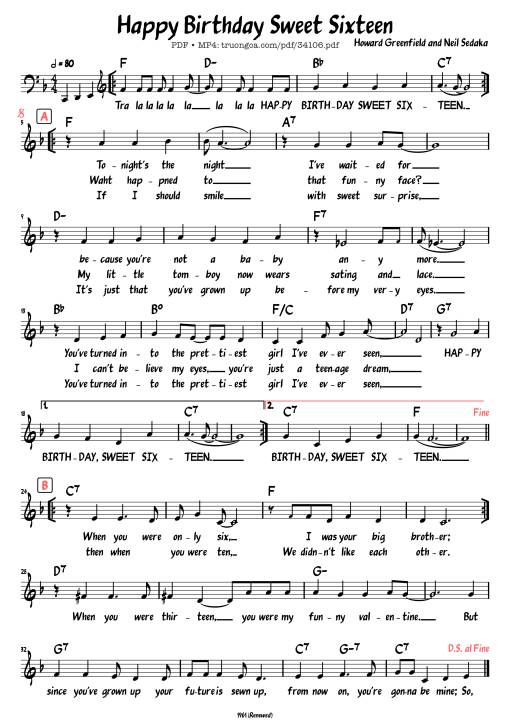
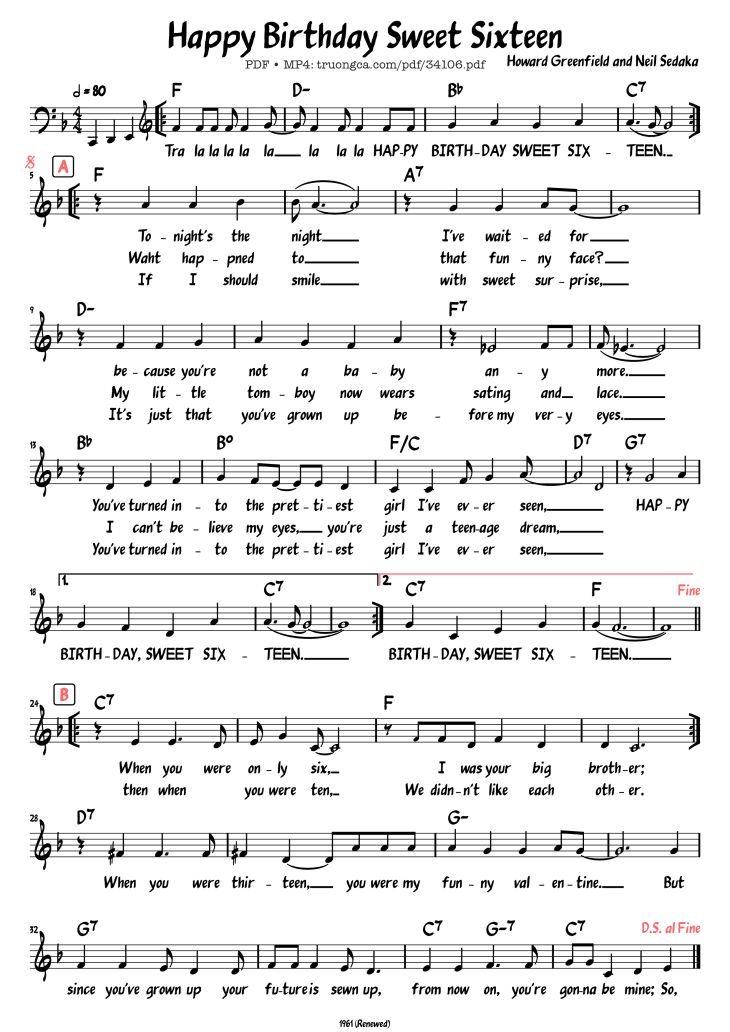
As this is an audio player, the processing may cause the sound to differ from the original MP3 or MIDI file, making it sound a bit "electronic." Please treat these playback samples strictly as reference guides to assist you in practicing Happy Birthday Sweet Sixteen. You can find the sheet music below; for the synchronized video and piano roll, please check the YouTube clip below or visit our YouTube channel.
More similar sheet PDFs: Happy Birthday Sweet Sixteen:
Sheet music và Sheet Piano Happy Birthday Sweet Sixteen by Howard Greenfield is shared here to help you practice singing effectively. The sheets with notes and MIDI & MP4 are provided for reference only and for non-commercial use. They may not be used for buying, selling, or any commercial activity. Copyright belongs to the songwriter/author and the respective copyright owners. PianoSnap.com does not own or claim any copyrighted content. You can download the high-quality PDF files with full music staff via the PDF link above.
Play Happy Birthday Sweet Sixteen
The videos/audio files Happy Birthday Sweet Sixteen by Howard Greenfield are embedded from YouTube, MuseScore, or other third-party sources. These videos are subject to third-party copyright control and may be removed in accordance with YouTube’s copyright rules or the policies of the respective platforms, and may include advertisements. If you are unable to access these songs, it means they may have been removed by the original source.
Lyrics & Chords Happy Birthday Sweet Sixteen
Howard Greenfield
Howard Greenfield and Neil Sedaka
Download and print in PDF or MIDI free sheet music of happy birthday sweet sixteen - Neil Sedaka for Happy Birthday Sweet Sixteen by Neil Sedaka arranged by Dick Schmitt for Piano
Learning Happy Birthday Sweet Sixteen by Howard Greenfield is a rewarding way to develop your piano skills. This Intermediate-level piece comes with a 1-page score, so an effective practice routine should match both the technical demands of the music and your current playing level.
How to Practice Happy Birthday Sweet Sixteen Effectively
Start with a short warm-up (5–10 minutes): Warm up your fingers with scales, five-finger patterns, or simple exercises. If the piece contains a particular technique that you find difficult, use a warm-up that prepares your hands for it.
As an Intermediate-level piece, Happy Birthday Sweet Sixteen requires more than simply learning the correct notes. Your practice should combine accuracy, coordination, rhythmic control, and musical expression.
Divide the score into focused sections: The 1-page score is easier to manage when you practice a few measures at a time. Mark transitions, repeated patterns, chord changes, and passages that consistently cause mistakes.
Practice difficult passages separately: When a section feels uncomfortable, stop playing the entire piece and isolate that passage. Practice the transition into the difficult section as well as the difficult notes themselves.
Use a metronome strategically: Start difficult passages slowly and increase the tempo gradually. If accuracy decreases when you speed up, return to the previous tempo instead of forcing the passage at full speed.
Practice hands separately when needed: Work on complicated rhythms, fingering, jumps, or chord patterns with each hand separately before putting them together. Then practice both hands at a slower tempo until the coordination becomes reliable.
Add musical expression: After the notes are secure, focus on dynamics, articulation, phrasing, balance between the hands, and the overall shape of each musical phrase.
Finish with a complete run-through: After focused practice, play as much of the piece as possible without stopping. This helps you connect the individual sections and discover whether a passage that works well on its own also works naturally within the complete piece.
Print and mark the sheet music: Print the score, make your own notes, and practice directly on the printed sheet. Writing and marking the music can help you remember difficult passages more easily.
Practice Tips for Happy Birthday Sweet Sixteen
Consistent practice is more useful than simply spending a long time at the piano.
Set a specific goal for each session, such as improving one difficult transition, increasing the tempo of a short passage, or making the melody more expressive.
As you become more comfortable with the piece, gradually move from technical practice toward a complete and musical performance.